
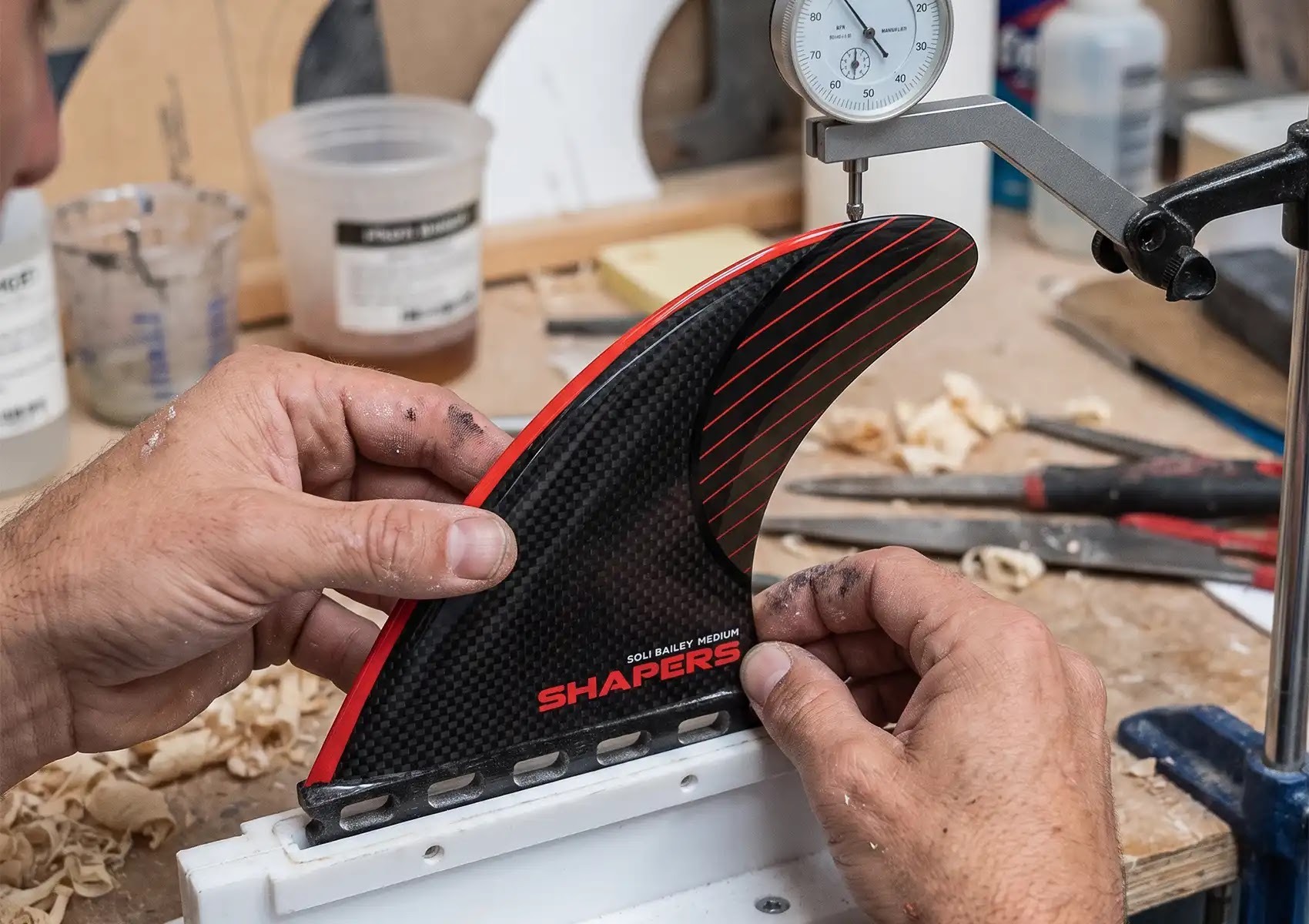
A finished fin might look simple, but most of what gives it character is hidden. Its curve, thickness, foil, edge, and flex all come from a series of careful steps, starting with the template and ending with the final inspection.
Surfboard fins are shaped through design, hand finishing, composite construction, and quality checks. Watching a fin move through each step shows just how much effort goes into something that seems simple at first.
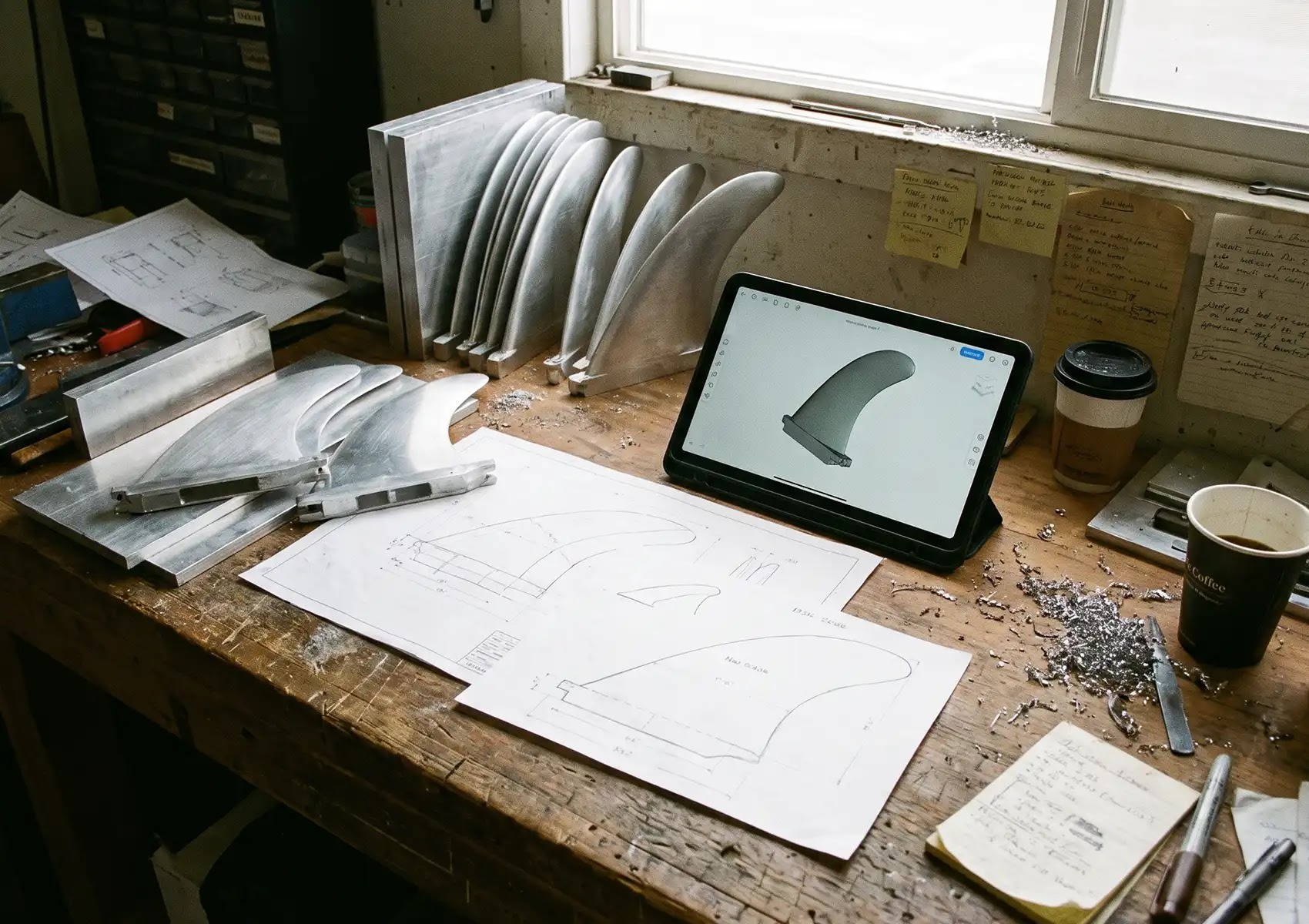
The Process Starts With a Template
Before there is a finished fin, there is a design.
The template sets the fin’s outline, like its base length, height, rake, and tip shape. The foil decides how thick the fin is in different places. These features work together to affect how the fin moves through water and performs on a board.
The material used at the start depends on how the fin will be made. Workshops might use a composite blank, a core material, or another pre-formed piece before shaping and laminating the fin.
Getting things right from the start is important. Even small changes in height, base length, or outline can change how a fin works. Fins made as a set also need to match each other closely.
The template is traced onto the material and cut out with some extra space around the edges. This extra material lets the builder make adjustments during shaping and foiling.
The Core Provides the Starting Structure
The core is just one part of the finished fin. It gives the starting structure that the rest of the fin is built around.
Before lamination, the material must be prepared. The surface is shaped, cleaned, and checked to make sure the laminate sticks well and the fin matches the design.
The materials and how they are layered can change depending on the fin. Fibreglass is common, but other materials are used when a different mix of stiffness, weight, or response is needed.
Building a fin is all about balance. Adding more material does not always make it better. Changes to the core, laminate, reinforcement, and thickness all affect how the fin performs when used.
Foiling Gives the Fin Its Profile
After the basic outline is set, the builder focuses on shaping the foil.
Foiling shapes how thick the fin is in different areas. The builder carefully removes material, aiming for the right profile and keeping the surfaces smooth and even.
Not every fin in a set has the same foil. Side fins and centre fins move through the water differently, so their shapes are designed to match their roles.
The front and back edges of the fin also need close attention. They must match the design and stay clean and even. Even small flaws can change how water flows around the fin, so precision is key here.
Experienced builders check their work in different ways. They look for changes in the surface, feel for small bumps or dips, and use measurements to make sure each fin is consistent.
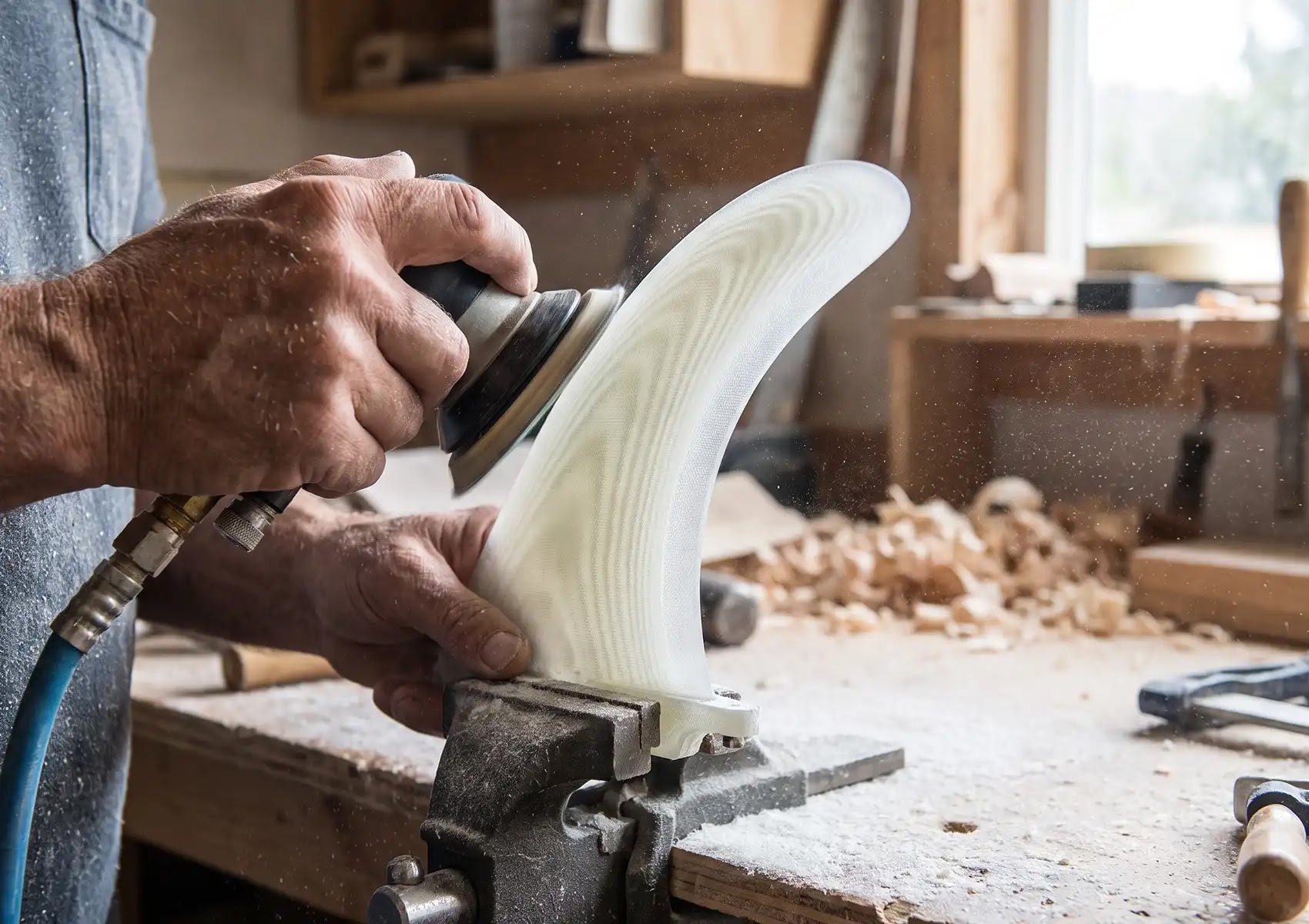
The process takes time. It is easy to remove material, but you cannot put it back. That is why careful builders work slowly toward the final shape instead of rushing.
Lamination Builds the Composite Structure
When the shape and foil are finished, the fin is ready for lamination.
Reinforcement material is cut to fit and placed around the core. Then, resin is added to soak the laminate and help it take the shape of the fin.
The layup must be neat and even, especially at the base. This part connects the fin to the board and has to match the requirements of the chosen fin system.
Curing is another key step. Different resins have their own working and curing needs, and things like temperature and preparation can change how the laminate turns out.
The fin needs time to cure before any more work is done. If you rush, it can hurt the construction or the surface, so patience is important.
The Base Needs to Fit the Fin System
Once the fin has cured, extra material is trimmed away, and the base is finished.
This is where building meets compatibility. A fin is not done just because it has the right shape. Its base must also fit the system it was made for, like Futures, FCS, or another type.
The hardware and base size are checked to make sure the fin fits properly in its box.
For sets of fins, consistency matters too. Each piece needs to match in size, shape, and build so the set works as it should.
Flex Is Part of the Finished Design
Flex does not come from just one thing. It depends on the materials, thickness, foil, reinforcement, and how the fin is built overall.
Two fins might look the same but feel different because their insides or thickness are not the same. A fin with more material in some spots will react differently than one made to be more flexible.
During the final inspection, the builder checks things like symmetry, weight, surface quality, and how consistent the fins are as a set.
Flex testing is not just about bending the fin as much as possible. It is about checking if the fin responds as it should and if all the fins in a set behave the same way.
This consistency really matters once the fins are on a board and put to the test during turns.
From the Workshop to Bali Surf
A fin might just look like a small, shiny piece of composite, but its real purpose shows once it is attached to a surfboard.
The features built into the fin affect how a thruster turns, how a quad keeps its speed, or how changing the fin size changes the feel between the surfer and the board.
This is where the workshop meets Bali surf. Fins are shaped and finished in a controlled space, but they are made to perform in the ocean.
For a Bali-based maker like Shapers Bali, the link between building and surfing is especially important. The workshop is part of a local surf culture where fins are made with Bali’s boards and waves in mind, not just as separate products.
